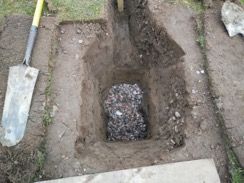

Rain is a part of everyday life in the UK. Here in Lancashire we certainly know that! All gardens need to drain well, unless you are trying to create a bog garden! There are a few reasons that water stands for more than a couple of hours after one of our deluges of rain. The main problem is heavy clay soil or in the case of a paved area, nowhere for the rain to run off to. So here we can see a couple of areas that the water is


standing. The problem with this is that the soil becomes saturated and cannot be stood on as this causes soil compaction. Compaction exacerbates the problem. It also means that the plants roots can’t take up the water. So, in effect the roots are as worse off than in dry moisture less soil.
If you find yourself with a garden that has a drainage problem it can limit many things. Such as what plants will grow and more importantly the use that you can get from the garden.
Solutions
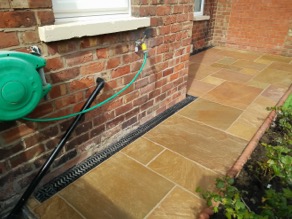
Thankfully there are ways to mitigate the problems of drainage. It really depends on how much of a problem it is. Does the water stay on the surface for days or a couple of hours? For hard surfaces a linear drain is a good way to remove the excess water. These are more easily fitted when installing new paving but the top photo shows that this can be retro fitted too. The linear channels consist of a U shaped open structure with a grid on the top to reduce debris and allow for walking over. The great thing about the design is that it’s simple and easy to remove the grid for cleaning the accumulation of dirt. Usually these channels are either connected to existing surface water drains or to a soak away in the garden.

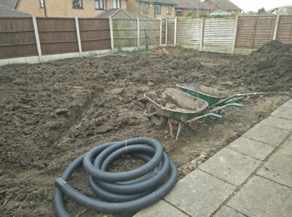
So, looking at the “Soft Areas” of the garden which includes lawns and borders there are different considerations. I would always advise a system of drainage know as a land drain. As you can see we have a main central drain with offsets to cover the affected areas. You can probably see in this photo the coiled perforated drainage pipe which is 100mm diameter.
The channels are dug out and we make sure that there is a good fall from the furthest spur to where the main pipe ends. Bedding gravel lines the trenches and then the pipework is connected. This can be covered with a geotextile. Then all the channels are back filled with the gravel and then soil to re-lay the turf on to. There is a good diagram further down which give a better idea as to how the pipes look under the ground.
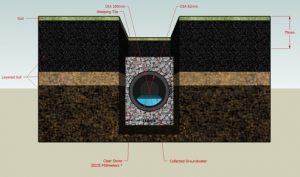
Thanks to Wikipedia for use of the diagram which is public domain.
The pipework then can lead to a soak away going down a meter or so or to a sump with a pump fitted to automatically pump the water out into an appropriate surface water drain. It would be rare that it would be possible to connect directly with a drain as the fall in the pipework would not allow this.
In dry weather, it is a good idea to relieve the surface compaction on the lawn. This is easily done with a core aerator or garden fork followed by a gritty top dressing. Borders can be made freer draining by adding a proprietary clay breaker and by adding horticultural sand which improves the structure of the soil.
If you have any of these flooding problems in your garden please feel free to get in touch with us for advice and quotations.